Showing posts with label Ancient Egypt. Show all posts

Tuesday, July 5, 2011

Famous Kings & Queens of Africa Series: Part 8


My stepmother/aunt was my regent until she declared herself pharaoh in 1473 since I was too young to rule. I was a successful general (the Napoleon of ancient Egypt), an acclaimed athlete, historian, and architect. Twenty years after the death of my stepmother/aunt, my son and I attempted to remove her image and name from historical and pharaonic  records. Statues were smashed and her cartouches and images were chiseled off stone walls that were visible and accessible. Many questioned our motives. Was I trying to prevent a dangerous precedent of a successful female king in Egyptian history? Or was I trying to return her to a queen regent position, claiming all her achievements as mine? Lastly, was I helping my son to ensure his elevation to pharaoh when I died, contributing her accomplishments to him? Who am I?

Hint: 

-Material Contributed by Sue Roberts 

Sunday, July 3, 2011

Famous Kings & Queens of Africa Series: Part 7

I was the first Nubian king, the first black pharaoh, to rule Egypt during the country’s 25th dynasty (747-716 BC). After years of dominance by Egypt, Nubia had embraced many Egyptian customs, and adopted Amun as the state religion. Many Nubians viewed Thebes as their spiritual home. When Egypt’s rulers were squabbling, I expanded Nubia’s power beyond Thebes into Lower Egypt. For me it was a Holy War, and as general, I had my solders cleanse themselves ritually before beginning battle. After a year-long campaign, the Egyptian kings capitulated. Despite complaints from my soldiers, I did not press further north. I returned home to Nubia, never to return to Egypt again. My energies were spent in making Napata the Karnak of Nubia. My Victory Stela at Gebel Barkal records my military feats and my preference for treaties and alliances instead of warfare. Who am I?


Hint: 


-Material contributed by Sue Roberts

Wednesday, June 29, 2011

Answer to Famous Kings & Queens of Africa Series: Part 6


Pharaoh Akhenaten (Originally Amenhotep IV, before he changed his name) 


Kings & Queens of Africa Series: Part 6

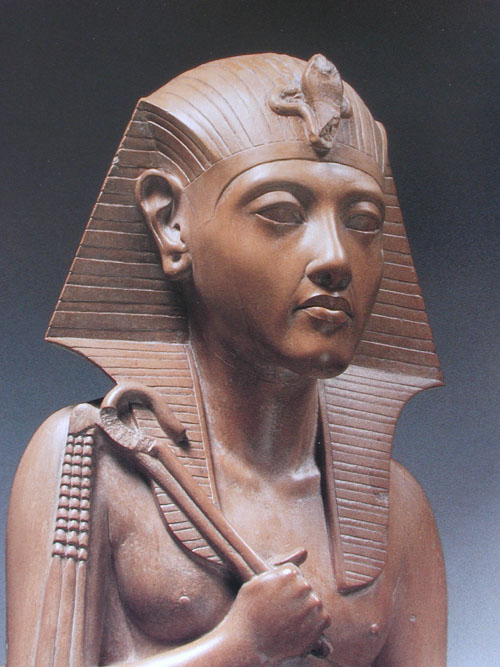
As a sickly child, I wasn’t interested in sports or learning how to fight. I studied hieroglyphic script and trained for the priesthood. When my older brother Tuthmose died, I was destined to succeed my father as the tenth king of Egypt’s Eighteenth dynasty. During my reign Egypt was enjoying peace and prosperity at the peak of its imperial glory. Together with my beautiful wife Nefertiti, we built a new capital in the middle of the desert and called it Akhetaten in honor of the sun disk Aten. I became known as the “Heretic King” because I banned all other gods except for Aten. The powerful priests were unhappy when I decreed that only the pharaoh could commune with Aten, breaking their power and the flow of royal offerings to them. I also influenced Egyptian culture by bringing realism to art. Statues and drawings of myself and family are depicted with elongated heads and faces and wide hips, instead of strong perfect muscular bodies. My successors Smenkhkare and Tutankhamun disassembled the temples and city I built. Who am I?


Hint: 


-Material contributed by Sue Roberts

Thursday, June 23, 2011

Answer to Famous Kings & Queens of Africa Series: Part 5

Queen Nefertiti 

 
  • While her husband, Akhenaten, attended to religious activities, she handled the political affairs of Egypt.  
  • Unlike many other pharaohs, Akhenaten was a warm family man. Queen Nefertari achieved many things with her husband.  
  • Like her husband, she adopted Aten, the sun-god.  
  • Together Akhenaten and Queen Nefertari built a new city dedicated to Aten called Akhetaten (Horizon of Aten). 

Wednesday, June 22, 2011

Kings & Queens of Africa Series: Part 5

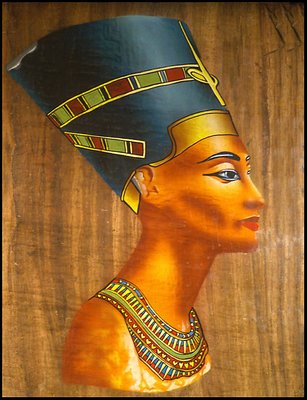
While my husband Akhenaten attended to religious activities, I handled the political affairs of Egypt. Unlike many other pharaohs, Akhenaten was a warm family man. We did many things together. Like my husband I adopted Aten, the sun-god. Together Akhenaten and I built a new city dedicated to Aten called Akhetaten (Horizon of Aten). The increased growth of my role over time was reflected in the size of my figure in paintings and statues. It was sad to have Akhenaten labeled as the “Heretic King”, and see his son Tutankhamun return to worshipping the god Amun. Who am I? 


Hint: 


Material contributed by: Sue Roberts

Tuesday, June 21, 2011

Answer to Famous Kings & Queens of Africa Series: Part 4

Queen Nefertari 


  • Her husband was Ramses the Great who ruled over Egypt for almost 70 years.  
  • Was known for her beauty and was called “The Most Beautiful of Them.” 
  • At Abu Simbel, a temple was dedicated to her and Hathor (goddess of love and joy).  
  • Unfortunately her life was cut short, but her daughter took her place with her father, Ramses, who had a beautiful tomb built in the Valley of the Queens with wonderful paintings on the walls.  
  • Her greatest treasure is the beautiful poetry by Ramses on the wall of her burial chamber.  


Monday, June 20, 2011

Famous Kings & Queens of Africa Series: Part 4

My husband was Ramses the Great who ruled over Egypt for almost 70 years. I was known for my beauty and was called “The Most Beautiful of Them.” My power was Ramses’ love for me. I attended many official state functions, and sometimes accompanied Ramses into battle. At Abu Simbel a temple was dedicated to me and Hathor (goddess of love and joy). Unfortunately my life was cut short, but my daughter took my place with her father. Ramses had a beautiful tomb built in the Valley of the Queens with wonderful paintings on the walls. My greatest treasure is the beautiful poetry by Ramses on the wall of my burial chamber. Who am I?


Hint: 


-Material contributed by Sue Roberts

Saturday, June 18, 2011

Answer to Famous Kings & Queens of Africa Series: Part 3

Queen Amanirenas 


  • In her culture, women were in control on earth and in the religious world. 
  • As Candace (or Kandake) of Kush (Nubia), she ruled from the palace and on the battlefield.  
  • When Rome demanded taxes from the Nubian people, she led the army into battle defeating the Roman soldiers.  
  • After losing an eye in battle, she was nicknamed the “One-eyed Candace” or “Warrior Queen”.  
  • She sent a bundle of golden arrows to Augustus Caesar as either a token of friendship or to be used in battle. A peace treaty was signed.  
  • The Roman army was impressed with the Kushite army’s determination and strength.  


Friday, June 17, 2011

Famous Kings & Queens of Africa Series: Part 3

In my culture women were in control on earth and in the religious world. As Candace (or Kandake) of Kush (Nubia), I ruled from the palace and on the battlefield. When Rome demanded taxes from the Nubian people, I led the army into battle defeating the Roman soldiers. After losing an eye in battle, I was nicknamed the “One-eyed Candace” or “Warrior Queen”. I sent a bundle of golden arrows to Augustus Caesar as either a token of friendship or to be used in battle. A peace treaty was signed. The Roman army was impressed with the Kushite army’s determination and strength. Who am I? 


Hint: 


-Material contributed by: Sue Roberts

Thursday, June 16, 2011

Answer to Famous Kings & Queens of Africa Series: Part 2

Queen Hatshepsut! 

 
  • Due to the untimely death of her young husband, she became the regent of her nephew, his successor.  
  • She seized the opportunity and donned the double-crown of Egypt, male clothing, and the false beard, declaring herself pharaoh of Egypt.   
  • She ruled for almost 22 years. 
  • Her goal as pharaoh was to expand Egypt’s trade routes.  
  • Her favorite sea expedition was to Punt.  
  • Unfortunately years after She died, her nephew attempted to erase any trace of her reign by disfiguring statues and walls of the buildings she had constructed. She is Queen Hatshepsut of Egypt. 


Wednesday, June 15, 2011

Kings & Queens of Africa Series: Part 2

Due to the untimely death of my young husband, I became the regent of my nephew, his successor. I seized the opportunity and donned the double-crown of Egypt, male clothing, and the false beard, declaring  myself pharaoh of Egypt. 


Surrounded by loyal and powerful officials, I ruled for almost 22 years. I shared a special relationship with my royal steward, Senemut. My goal as pharaoh was to expand Egypt’s trade routes. My favorite sea expedition was to Punt. Upon return the ship was burdened with 31 live myrrh trees to be transplanted in the courts of my mortuary temple. Unfortunately, years after I died, my nephew attempted to erase any trace of my reign by disfiguring statues and walls of the buildings I had constructed. Who am I? 


Hint: 


-Material contributed by: Sue Roberts

Saturday, May 14, 2011

Origins of Museum Africa: Punt!


It’s a region of Ancient Egypt, south of Egypt, around the Res Sea. It was a region for trade and commerce. Some attribute the region to modern day Somalia, Ethiopia, Djibouti, and Yemen, but no one knows the precise location of the region.
Here’s an imaginative description of the region:
It seems to have been considered by them a most unique haven; an emporium of goods for both king and gods, and gradually acquired an air of fantasy, like that of Eldorado or Atlantis. For this reason, it was sometimes featured in narrative tales such as the Tale of the Shipwrecked Sailor.

For more on the region of Punt, visit Tour Egypt: http://www.touregypt.net/featurestories/punt.htm

Wednesday, May 11, 2011

Origins of Museum Africa: The Kingdom of Kush


Kush (or Cush) was a kingdom/country in northeast Africa (think Sudan/Ethiopia/Egypt), part of Ancient Nubia, a region of the Nile valley.

The Kingdom of Kush was very much an independent nation, which was prominent around the 11th century BCE to the 4th century CE.

The Kushites conquered and controlled upper Egypt, while the Piankhi ruled the south of Egypt.

The Kingdom remained strong until the 4th century CE, when it fell to the Ethiopians. It was known as one of the most prominent kingdoms of its time.


For more on the kingdom/country of Cush, see See A. J. Arkell, A History of the Sudan to A.D. 1821 (1955, repr. 1974). 

Monday, May 9, 2011

Origins of Museum Africa: What is Kemet?


Km.t (also known as Kemet) is one of the names for Ancient Egypt. The word itself means the black place or the black land.
Kemet soil is known to be the more fertile soil the desert soil of other Egyptian lands. In that respect, the name is used as a reference to black soil that was eroded from Central Africa by the Nile River.
In reference to Km.t people, the word Kemet is used to describe the people who lived in the black, fertile land of the country.
Here’s the dilemma though:
·      Some scholars differ on the origin of the word though—scholars like Raymond Faulkner believe the word was derived from the land, the dark soil of the region.
·      Others like William Leo Hansbery and Aboubacry Moussa Lam claim that the word was derived from the skin color of the people of the region.
So whose side are you on? The word—Kemet—a reference to the land or the people?
Leave your comments below!